
22 min readworking paper
Project Casper
Focusing on the next generation of multi-dimensional generation models
ClockingMinds Research
Ask an image model for a woman holding a coffee cup at a kitchen counter and it will give you something beautiful. Ask for the same kitchen from the doorway and you will get a different kitchen. The window moves. The counter changes material. The cup has a new handle. Nothing about the first picture constrains the second, because there was never a kitchen. There was only a picture of one.
This is the quiet limit of today's generative models. They are extraordinary painters with no memory of the room they are painting. Most of what people call hallucination in images, the sixth finger, the strap that passes through a shoulder, the logo that rearranges itself between frames, is not a failure of taste. It is the absence of a world.
Project Casper is our research direction on that absence. The name is a ghost: the invisible structure that sits behind every image, the thing you can see through. This paper lays out how image models work, where spatial reasoning breaks, what the field has learned about giving models geometry, and the bet we are making. It is a working paper. We describe a direction and our reasoning, not finished results.
1.How an image model paints
Nearly every frontier image and video model today is a diffusion model or a close relative[1][2]. The idea is simple to state. Take a real image, add a little Gaussian noise, then a little more, until after enough steps nothing remains but static. Train a network to undo one step. Then start from pure static and run the network backwards.
Formally, the forward process mixes a clean image with noise according to a schedule . Because each step is Gaussian, any step can be sampled directly:
A network learns to predict the noise that was added, given the noisy image, the step, and a condition such as a text prompt. The training objective is a plain squared error:
Sampling runs the chain in reverse, subtracting a scaled estimate of the noise at each step and adding a small amount back to keep the process stochastic. Structure appears coarse to fine, and nowhere in the loop is there a scene, only increasingly confident pixels:
Modern systems run this loop in a compressed latent space rather than on raw pixels[3], and have moved the denoiser from convolutional U-Nets to transformers, which scale more predictably with compute[4]. How quickly signal is destroyed is a design choice. The cosine schedule keeps more of the image alive in the middle steps than the original linear one, which is where global layout gets decided[5].
Text steering comes from classifier-free guidance, which extrapolates from an unconditioned prediction toward a conditioned one[6]:
Read that equation closely and the problem appears. Everything the model knows about the scene has to arrive through or live implicitly in its weights. A sentence is a remarkably poor description of a room.
2.Where the world goes missing
A diffusion model learns a distribution over images, . It never learns a distribution over scenes. Geometry, occlusion, contact, and scale are whatever was statistically typical in its training pixels. When a prompt pins them down, the model obliges. When it doesn't, they are free variables, and sampling fills them with something plausible. Plausible and correct are different things.
The benchmarks are blunt about this. GenEval checks simple, verifiable properties of generated images with an object detector. On its position task, which only asks whether one object sits left of, right of, above, or below another, SDXL scored 0.15 in the original paper, against 0.98 for simply rendering a single named object[7]. T2I-CompBench finds the same pattern across spatial relations, attribute binding, and object counts[8]. Models know what things look like far better than where things are.
Video makes the gap visible. A moving camera is a continuous demand for geometric consistency. OpenAI's Sora report noted that 3D consistency and object permanence emerged with scale, without explicit 3D supervision, and also that the model still fails to simulate basic physical interactions like glass shattering[9]. That is the honest state of the field: spatial structure can emerge from data, partially, and it degrades exactly where you most need it.
There is a simple reason partial is not enough. A scene is not one constraint, it is dozens. The strap meets the shoulder. The shadow falls away from the window. The bag is the same size in both hands. If each is held independently with probability , the chance an image holds all of them is:
This is the core claim of the paper. Hallucination in generated scenes is, to a first approximation, an under-constraint problem. You do not fix it by making the painter more talented. You fix it by giving the painter a room.
3.What a spatial construct is
Computer vision has a precise language for rooms, and it predates deep learning by decades[10]. A point in the world lands on a pixel through a camera's intrinsics and its pose, a rotation and translation :
The division by depth is where a single image loses information. Every point along a ray through the camera center lands on the same pixel. A second view resolves it: the candidates spread out along a line in the other image, and only one of them matches.
A spatial construct, as we use the term, is any representation that makes these relationships explicit and checkable: where surfaces are, how the cameras relate, what is in front of what. The field has built several, each with a different trade between fidelity, speed, and editability.
Neural radiance fields store a scene as a function from position and viewing direction to density and color, and render by integrating along rays[11]. 3D Gaussian splatting replaces the function with millions of explicit, anisotropic primitives that render in real time at 1080p[12]. Both produce a pixel by alpha compositing whatever lies along its ray, front to back:
That one line is the difference between a picture and a world. Occlusion, depth order, and view consistency are not learned tendencies here. They are arithmetic.
| Representation | Stores | Strength | Limit |
|---|---|---|---|
| Pixels (2D diffusion latents) | Appearance only | Photoreal, fast, trained on billions of images | No state. Geometry is implied by the image, never held by the model |
| Depth and normal maps | Distance and surface orientation per pixel, one view | Cheap to estimate, a strong conditioning signal | One view only. Nothing exists behind what the camera sees |
| Point maps (DUSt3R, VGGT) | A 3D point for every pixel, plus the cameras | Feed-forward. Geometry from ordinary photos in seconds | A measurement, not a renderer. Thin on appearance |
| Neural radiance fields | Density and color as a function of position and view | View-consistent by construction | Slow to fit, one scene at a time, hard to edit |
| 3D Gaussian splats | Millions of explicit, editable primitives | Real-time rendering, objects can be moved and swapped | Per-scene optimization, heavy memory, weak on unseen sides |
| Video world models | An implicit state carried across frames | Motion, interaction, emergent object permanence | Memory is bounded. Consistency decays as the clip gets longer |
4.What the field has learned
The last four years have produced four distinct strategies for marrying image priors to geometry. Each one taught us something.
Lift 2D into 3D. DreamFusion showed that a frozen 2D diffusion model can supervise a 3D scene with no 3D training data, by rendering the scene, noising the render, and pushing the scene toward whatever the denoiser prefers[13]. The gradient, score distillation sampling, is:
It works, slowly, and inherits every inconsistency of the 2D prior, including the well-known tendency to put a face on the back of a head. Zero-1-to-3 fine-tuned a diffusion model on the relative camera transform between views[14], and MVDream generated several views jointly with attention shared across them[15]. Consistency improved when views were generated together rather than one at a time.
Condition on geometry. ControlNet showed that a pretrained generator can be made to obey a depth map, edge map, segmentation, or pose skeleton by training a parallel copy of its encoder while the original stays frozen[16]. The generator keeps its taste and gains a spine. Monocular depth estimators such as Depth Anything, trained on tens of millions of unlabeled images, now make those depth maps available from any photograph[17].
Recover geometry feed-forward. DUSt3R regressed dense 3D point maps from pairs of ordinary photos with no known camera parameters[18]. VGGT extended this to predict cameras, depth, and point maps from one to hundreds of views in a single forward pass, in under a second[19]. Geometry stopped being an optimization problem and became an inference call.
Simulate the world. Video world models carry an implicit state forward in time. Genie 2 generated playable 3D environments from a single image[20], and Genie 3 extended this to real-time interaction at 720p and 24 frames per second, staying consistent for a few minutes[21]. The ambition is right. The state is still implicit, which means it is still forgettable.
5.Project Casper
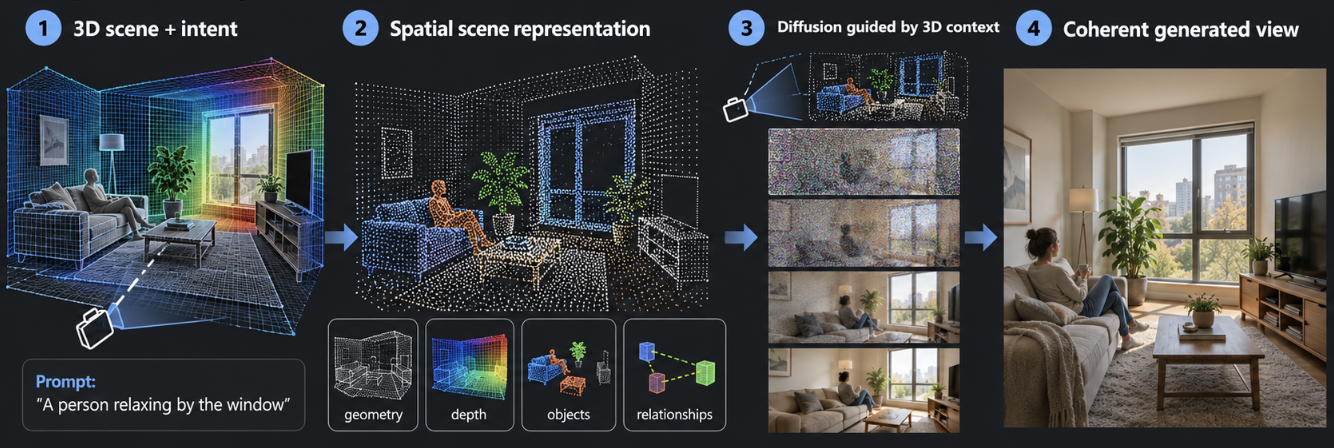
Casper is our attempt to take that pattern to its conclusion for one domain: images of a specific person, in a specific place, with a specific product. We believe the next generation of generative models will not paint into a blank canvas. They will generate from a scene: an explicit, persistent, multi-dimensional state that the model renders, conditions on, and is held accountable to.
State before pixels
Decide where everything is before deciding what anything looks like. A scene that is never written down cannot be kept consistent.
Structure is given, not guessed
Don’t ask a generator to remember geometry it was never shown. The scene is known before the first pixel is drawn.
Generate inside, not around
The model is free on texture, light, and mood. It is not free on where the product sits or what shape the face is.
Verify against the world
An image is accountable to the scene it came from. A hallucination becomes a measurable disagreement, not a judgment call.
The practical consequence is that consistency stops being a hope and becomes a property you can measure. When a scene is written down, two views of it either agree about the surfaces they share or they don't. A face either matches the person it belongs to or it doesn't. A product either keeps its shape and surface or it doesn't. A hallucination stops being a vibe and becomes a disagreement with a threshold.
The literature already shows that sampling can be steered by signals outside the prompt[22], and that generators can be made to obey structure they were never trained to infer[16]. Casper builds on both ideas. What is new is less any single mechanism than the decision to make one persistent scene the shared source of truth for everything that happens before, during, and after generation.
6.Why commerce is the right first world
General world models have to be right about everything. Commerce only has to be right about three things, and it has to be right about them every time: the person looks like themselves, the product looks exactly like the product, and the scene is somewhere they could plausibly be. Subject-driven methods such as DreamBooth showed that a model can learn a specific person or object from a handful of photos[23]. Keeping that subject correct across poses, rooms, and lighting is a spatial problem, which is why we think it is the frontier.
It is also a domain with a ground truth. Every product has a reference image. Every person has a selfie. The scene state can be checked against real inputs, which makes commerce an unusually honest testbed for spatial generation: errors are visible, measurable, and expensive.
Our first product, Reflection, already turns a brand's existing product imagery into personalized creative. In preliminary internal estimates, 70 percent of outputs meet our product fidelity criteria and 60 percent are usable without manual edits. Casper is aimed squarely at the remainder. The failures we see are almost never about style. They are about space: a strap that floats, a scale that drifts, a product that changes shape when the camera moves.
7.Open problems
We would rather name the hard parts than pretend they are solved. These are the questions we are working on and do not yet have answers to.
Capturing state from one photo
Most people share one selfie, not a scan. Recovering usable geometry from a single casual image is still an estimate, and the unseen side of everything is a guess.
Deformable things
Rigid products are tractable. Fabric that drapes, folds, and stretches over a body is not, and apparel is most of what people buy.
Light that agrees
Inserting an object with correct geometry but the wrong shadows reads as fake instantly. Estimating and matching illumination remains open.
Verifiers that can be fooled
A check is only as good as the model doing the checking. If the verifier and the generator share blind spots, errors pass both.
Cost per image
Every extra constraint and every retry costs compute. One-to-one only works at cents per output, so consistency has to be cheap, not just possible.
Where this leaves us
The first generation of generative models learned what the world looks like. The next generation will have to learn where the world is. We think that shift, from pixels to scenes, from appearance to state, is the most important open problem in visual generation, and the one most directly tied to whether people can trust what they see.
If you work on 3D vision, world models, or generative evaluation and see a flaw in this reasoning, we want to hear it. That's the most useful email we can get: founders@clockingminds.com.
References
- [1]Ho, J., Jain, A., & Abbeel, P. (2020). Denoising diffusion probabilistic models. NeurIPS 33. link
- [2]Song, Y., Sohl-Dickstein, J., Kingma, D. P., Kumar, A., Ermon, S., & Poole, B. (2021). Score-based generative modeling through stochastic differential equations. ICLR. link
- [3]Rombach, R., Blattmann, A., Lorenz, D., Esser, P., & Ommer, B. (2022). High-resolution image synthesis with latent diffusion models. CVPR. link
- [4]Peebles, W., & Xie, S. (2023). Scalable diffusion models with transformers. ICCV. link
- [5]Nichol, A. Q., & Dhariwal, P. (2021). Improved denoising diffusion probabilistic models. ICML. link
- [6]Ho, J., & Salimans, T. (2022). Classifier-free diffusion guidance. arXiv:2207.12598. link
- [7]Ghosh, D., Hajishirzi, H., & Schmidt, L. (2023). GenEval: An object-focused framework for evaluating text-to-image alignment. NeurIPS Datasets and Benchmarks. link
- [8]Huang, K., Sun, K., Xie, E., Li, Z., & Liu, X. (2023). T2I-CompBench: A comprehensive benchmark for open-world compositional text-to-image generation. NeurIPS Datasets and Benchmarks. link
- [9]OpenAI. (2024). Video generation models as world simulators. Technical report. link
- [10]Hartley, R., & Zisserman, A. (2004). Multiple View Geometry in Computer Vision (2nd ed.). Cambridge University Press.
- [11]Mildenhall, B., Srinivasan, P. P., Tancik, M., Barron, J. T., Ramamoorthi, R., & Ng, R. (2020). NeRF: Representing scenes as neural radiance fields for view synthesis. ECCV. link
- [12]Kerbl, B., Kopanas, G., Leimkühler, T., & Drettakis, G. (2023). 3D Gaussian splatting for real-time radiance field rendering. ACM Transactions on Graphics, 42(4). link
- [13]Poole, B., Jain, A., Barron, J. T., & Mildenhall, B. (2023). DreamFusion: Text-to-3D using 2D diffusion. ICLR. link
- [14]Liu, R., Wu, R., Van Hoorick, B., Tokmakov, P., Zakharov, S., & Vondrick, C. (2023). Zero-1-to-3: Zero-shot one image to 3D object. ICCV. link
- [15]Shi, Y., Wang, P., Ye, J., Long, M., Li, K., & Yang, X. (2024). MVDream: Multi-view diffusion for 3D generation. ICLR. link
- [16]Zhang, L., Rao, A., & Agrawala, M. (2023). Adding conditional control to text-to-image diffusion models. ICCV. link
- [17]Yang, L., Kang, B., Huang, Z., Xu, X., Feng, J., & Zhao, H. (2024). Depth Anything: Unleashing the power of large-scale unlabeled data. CVPR. link
- [18]Wang, S., Leroy, V., Cabon, Y., Chidlovskii, B., & Revaud, J. (2024). DUSt3R: Geometric 3D vision made easy. CVPR. link
- [19]Wang, J., Chen, M., Karaev, N., Vedaldi, A., Rupprecht, C., & Novotny, D. (2025). VGGT: Visual geometry grounded transformer. CVPR. link
- [20]Parker-Holder, J., et al. (2024). Genie 2: A large-scale foundation world model. Google DeepMind. link
- [21]Google DeepMind. (2025). Genie 3: A new frontier for world models. link
- [22]Dhariwal, P., & Nichol, A. (2021). Diffusion models beat GANs on image synthesis. NeurIPS 34. link
- [23]Ruiz, N., Li, Y., Jampani, V., Pritch, Y., Rubinstein, M., & Aberman, K. (2023). DreamBooth: Fine tuning text-to-image diffusion models for subject-driven generation. CVPR. link